
The Ministry of Hajj and Umrah has announced the departure of the final cohort of the Guests of Allah for the 1447 AH Hajj season. This was accomplished amidst an integrated ecosystem of services mobilized by the Kingdom for the pilgrims from the moment of their arrival on its lands until their departure to their home countries across all land, sea, and air ports, enabling them to perform their rituals with ease and tranquility.
The Ministry emphasized that the success of this Hajj season was achieved by the grace of Allah, followed by the support and dedication bestowed upon the ecosystem serving the Guests of Allah by the Custodian of the Two Holy Mosques, King Salman bin Abdulaziz Al Saud, and His Royal Highness Prince Mohammed bin Salman bin Abdulaziz Al Saud, Crown Prince and Prime Minister—may Allah protect them—and under the direct oversight of His Royal Highness Prince Abdulaziz bin Saud bin Naif, Minister of Interior and Chairman of the Supreme Hajj Committee. This success is further credited to the continuous efforts of the Emirates of Makkah and Madinah, alongside seamless integration among various government and service entities. This embodies the objectives of Saudi Vision 2030 and the Pilgrim Experience Program in elevating service quality and enriching the journey of the Guests of Allah.
The Ministry explained that its services continued until the departure of the final pilgrim, driven by a comprehensive operational, digital, and on-ground ecosystem. This included orientation, care, oversight, awareness, and field support services, which contributed to completing the journey of the Guests of Allah with utmost ease and smoothness.
The Ministry had already commenced its preparations for the upcoming 1448 AH Hajj season on the twelfth of Dhu al-Hijjah 1447 AH, by announcing the delivery of the preliminary arrangements document to the Hajj Affairs Offices, signaling the launch of early preparation efforts for the next season. This was followed by a comprehensive evaluation of the current season, identifying opportunities for improvement, and coordinating with relevant entities to enhance readiness, elevate service quality, and continue developing the experience of the Guests of Allah.
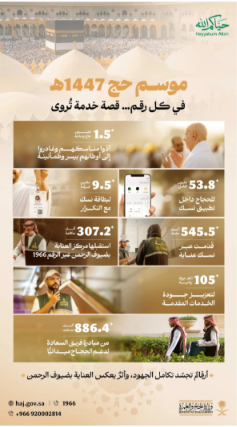
The 1447 AH Hajj season witnessed a significant advancement in the digital services ecosystem via the “Nusuk” application, which features more than 130 digital services. The platform recorded approximately 54 million interactions from pilgrims, and its user base exceeded 1.3 million pilgrims during the season. Furthermore, the usage of Islamic services within the app crossed 6 million times, while the number of read awareness, guidance, and health notifications surpassed 22 million. Additionally, more than 518,000 pilgrims benefited from the “Digital Mutawwif” service, around 959,000 pilgrims utilized “Nusuk” maps, reads of the guidance content within the Hajj guide inside the app exceeded 610,000, and scanning operations for the “Nusuk Card” crossed 9.5 million during the season.
In terms of caring for the Guests of Allah, “Nusuk Enayah” centers delivered more than 545,000 services. Meanwhile, the Guests of Allah Care Center received approximately 307,000 calls via its unified hotline (1966) in more than 11 languages. This was accompanied by the distribution of nearly 670,000 awareness and guidance materials. Additionally, more than 886,000 pilgrims benefited from the “Happiness Team” initiative, which provided on-ground guidance, support, and assistance to pilgrims throughout the season.
Under the framework of the “Luggage-Free Pilgrim” initiative, the total number of bags shipped during the arrival and departure phases reached approximately 2.9 million, marking an increase of over 106% compared to the 1446 AH Hajj season. This included more than 1.58 million bags during the arrival phase and over 1.31 million bags during the departure phase.
The initiative also contributed to reducing airport check-in and travel procedure times from two hours down to just 15 minutes, thereby boosting operational efficiency, saving time and effort, and enriching the experience of the Guests of Allah until their departure.
The Ministry added that it executed more than 105,000 inspection tours across various service locations, which contributed to reducing operational observations by 39% compared to the previous Hajj season, reflecting the effectiveness of the supervisory framework and continuous improvement efforts to elevate service quality.
The Ministry of Hajj and Umrah concluded by affirming that the achievements realized during the 1447 AH Hajj season embody the ongoing development of the ecosystem serving the Guests of Allah. This is sustained through integration among government entities and investments in digital technologies and smart solutions, which enhance service quality, fulfill the objectives of Saudi Vision 2030, and solidify the Kingdom’s position as a global model in serving the Guests of Allah—ensuring that the pilgrim’s journey remains a comprehensive and seamless experience that begins well before arrival and continues with ease and tranquility until departure.